All modules
    Competitive Intelligence

    Competitive Intelligence

    In AI search, citation share is the new ranking position. Competitive Intelligence shows you which competitors AI platforms prefer to mention, on which platforms, and for which queries. So you know exactly where you're losing ground and what to do about it.

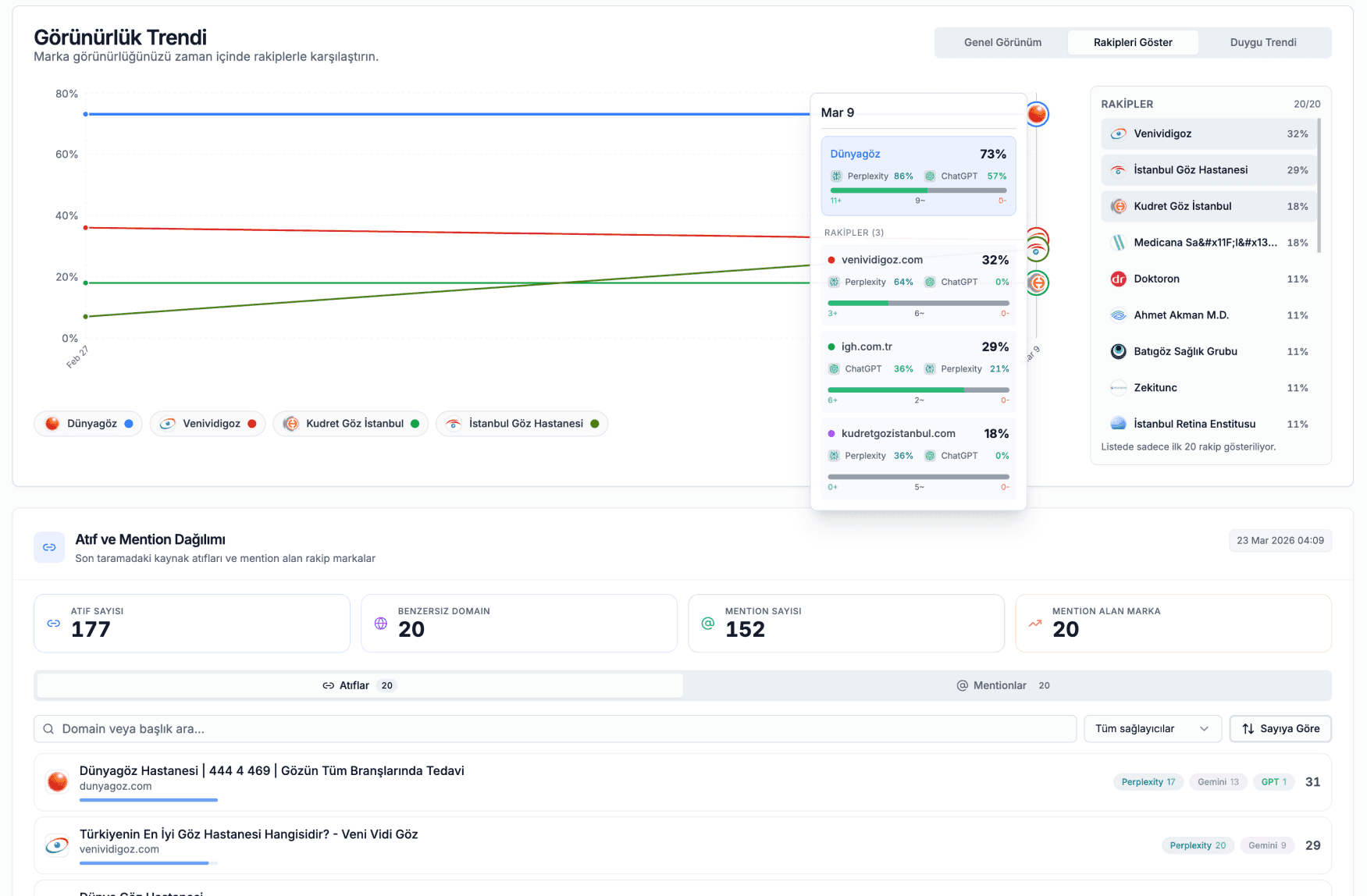
    Visibility Trends with Competitors
    Comparison chart showing brand visibility versus competitors.

    What this module does

    Each capability solves a distinct problem inside this module. Skim the list to see what ships out of the box.

    • Visibility trends chart: your brand vs. up to 20 competitors over time
    • Per-competitor platform breakdown: see which AI prefers which brand and why
    • Question coverage table: which queries your brand answers vs. which go to competitors
    • Sentiment comparison: positive/neutral/negative breakdown for you and each competitor

    What you measure and what changes

    The metric this module tracks and the practical outcome you should see after a few cycles in a workspace.

    What you measure

    Brand vs. competitor AI citation share

    What changes

    Targeted content and schema close specific visibility gaps

    Once you see that a competitor ranks higher on Perplexity for a specific question cluster, you have a concrete target. Add the right schema, publish a direct answer, and track whether that gap closes in the next scan cycle.

    Eight engines, weighted to reflect real citation impact

    Competitive scoring runs against the same eight AI engines as the visibility module (ChatGPT, Perplexity, Gemini, Claude, Grok, DeepSeek, Meta AI, GLM) but the math is different. Not every engine's citation carries the same revenue impact for your category. The scoring service ships with explicit per-engine weights: Perplexity 1.2, Google 1.1, OpenAI 1.0, Anthropic 0.9, xAI / DeepSeek / Meta 0.8, GLM 0.7.

    These weights are deliberate. Perplexity surfaces 4 to 7 sources per response so brand mentions there reach further. Google AI Overviews still routes traffic on top of organic results. DeepSeek and GLM see real volume but in narrower geographic and language contexts. Your brand score (0 to 100) is the weighted total across engines, and your competitive rank (1 = best) is computed against every active competitor in your workspace.

    Your market share estimate is your score divided by the total of every active competitor's score plus yours. The trend chart shows up to 12 recent snapshots, about a year of monthly data, so you read the long arc of your share rather than just last week's spike.

    Won, overlap, and lost questions

    Every scan against every question ends in one of three outcomes: only your brand was mentioned (won), both your brand and a competitor were mentioned (overlap), or only the competitor was mentioned (lost). The scoring service tallies these for every scan so the chart answers the strategic questions directly. Where do you own the answer, where do you share it, where do you lose it entirely?

    Per-competitor metrics break the picture down further: a 0-100 score, a mention rate (how often the competitor appears across all questions), an overlap rate (how often you both surface), a lost rate (how often only they show up), an engine-by-engine score breakdown, and sentiment counts. When a competitor lands inside a numbered list, the position is also recorded. First place gets cited; fifth place gets ignored.

    On the visibility chart, the comparison view caps at 4 competitors selected at once so the line graph stays readable. The top 3 by current score are auto-selected when you open the page. Your competitor library can hold many more than 4; that limit applies to the chart, not the storage.

    Auto-discover competitors instead of typing them

    Manual competitor entry is fine if you already know who you compete with. Most workspaces don't, or work with outdated assumptions. Brandop's competitor discovery asks ChatGPT and Perplexity directly, with prompts shaped from your industry and brand keywords: who do AI search engines themselves consider you against?

    A discovery run produces up to 30 candidates and automatically merges duplicates, so re-running doesn't multiply the list. Each new competitor is enriched on the fly: favicon, logo, site title, and brand keywords are fetched in the background. Manual entry stays available for niches the discovery doesn't cover.

    Removing a competitor is a soft delete: the rival is hidden from the active list but every historical mention stays in place. Trend continuity is preserved even after a competitor is dropped, and bringing them back later doesn't lose any data.

    Sparse storage, dense charts

    Tracking visibility across dozens of competitors and eight AI engines could easily turn into millions of empty data points. Brandop's storage stays lean: only mentions that actually happened are stored, and the ratios are computed when you open the chart. Your dashboards stay fast as your tracking list grows.

    A competitor that hasn't been mentioned yet still appears with a zero on every chart, so the trend line stays continuous. A drop from 12% to 0% reads as a real decline rather than missing data, and a new competitor you just added doesn't make the line jump.

    The visibility chart ships three trend tabs (Overview, Competitors, Sentiment) with smooth line and pie visualisations. Below the chart, citation and mention panels each carry a search box, a multi-select engine filter, sort by count or domain or name, and 8-per-page pagination. The default time range is 30 days; co-mention tooltips reveal which engines cited you and a given competitor in the same answer.

    See it working

    The examples below show how this capability works inside a real workspace. No mockups. This is exactly what you see when you sign in.

    Semantic Understanding

    How Search Engines Really Use Schema

    Schema markup is not just about rich snippets. It helps search engines understand the meaning of your content, recognize entities and build connections in the Knowledge Graph.

    Page Content:

    "Dr. Smith provides treatment for patients at the Your Medical Center..."

    Possible meanings of "Treatment":Medical ProcedureWay of HandlingChemical ProcessSpa Service
    Without Schema
    Search Engine Processing
    Content Understanding

    Text about 'treatment' with 'patients' and 'center'

    Indexing Decision

    Could be healthcare, customer service, or wellness

    Entity Recognition Confidence
    47%
    Cannot connect to Knowledge Graph
    Ambiguous - may be indexed incorrectly
    With Brandop
    Search Engine Processing
    Entity Recognized
    @type: MedicalOrganization

    Your Medical Center

    Categorized As

    Healthcare > Medical Facilities

    Entity Recognition Confidence
    98%
    Knowledge Graph Connections
    Type: HospitalService: Patient CareStaff: Dr. Smith (Physician)
    Clear - indexed in the right context

    What Search Engines Do With Schema Data

    Entity Recognition

    Identifies exactly what your content refers to and removes ambiguity

    Knowledge Graph

    Connects your content with large-scale entity databases

    Proper Indexing

    Helps pages appear for the right queries in the right context

    Cross-Reference

    Links entities with authoritative sources and references

    Schema helps search engines understand meaning, not just keywords
    AI Output Quality

    How AI Answers Improve With Schema

    Compare generic AI answers versus rich, trusted responses powered by structured data.

    What are the best wireless headphones at AudioTech Store?

    Without Schema
    AI Assistant

    AudioTech Store sells wireless headphones. You can visit their website to see their products and prices. They have various models available for purchase.

    Missing information:

    No specific product info
    No pricing
    No ratings
    Generic response
    With Brandop
    AI AssistantEnhanced

    AudioTech Store offers the Wireless Bluetooth Headphones - a top-rated product:

    Price: $149.99 (In Stock)

    Rating: 4.7/5 from 2,847 reviews

    Features: Premium noise-cancelling, 30-hour battery life

    Brand: AudioTech Pro

    This is their best-selling model with excellent customer satisfaction.

    Rich data included:

    Specific product details
    Real-time pricing
    Customer ratings
    Stock status

    Optimized for modern AI assistants

    ChatGPT
    Perplexity
    Claude
    Gemini
    Grok
    DeepSeek
    GLM
    Meta AI
    Give AI systems the right structured signals to represent your brand accurately.
    Competitive Intelligence | Brandop